Please rotate your device
To continue exploring this website, please rotate your device to a vertical orientation


MOSS Transcribe Diarize
OpenMOSS-Team/MOSS-Transcribe-Diarize
MOSS-Transcribe-Diarize is an end-to-end audio model for long-form multi-speaker transcription, diarization, timestamps, and acoustic event awareness.
MOSS-Transcribe-Diarize 0.9B is an end-to-end audio model that transcribes speech, labels speakers, and adds timestamps in a single pass, turning long, multi-speaker recordings into structured "who said what."
It supports 50+ languages, single-pass inference on recordings up to 90 minutes, acoustic-event awareness, and custom hotword prompting for domain-specific terms.
Performance
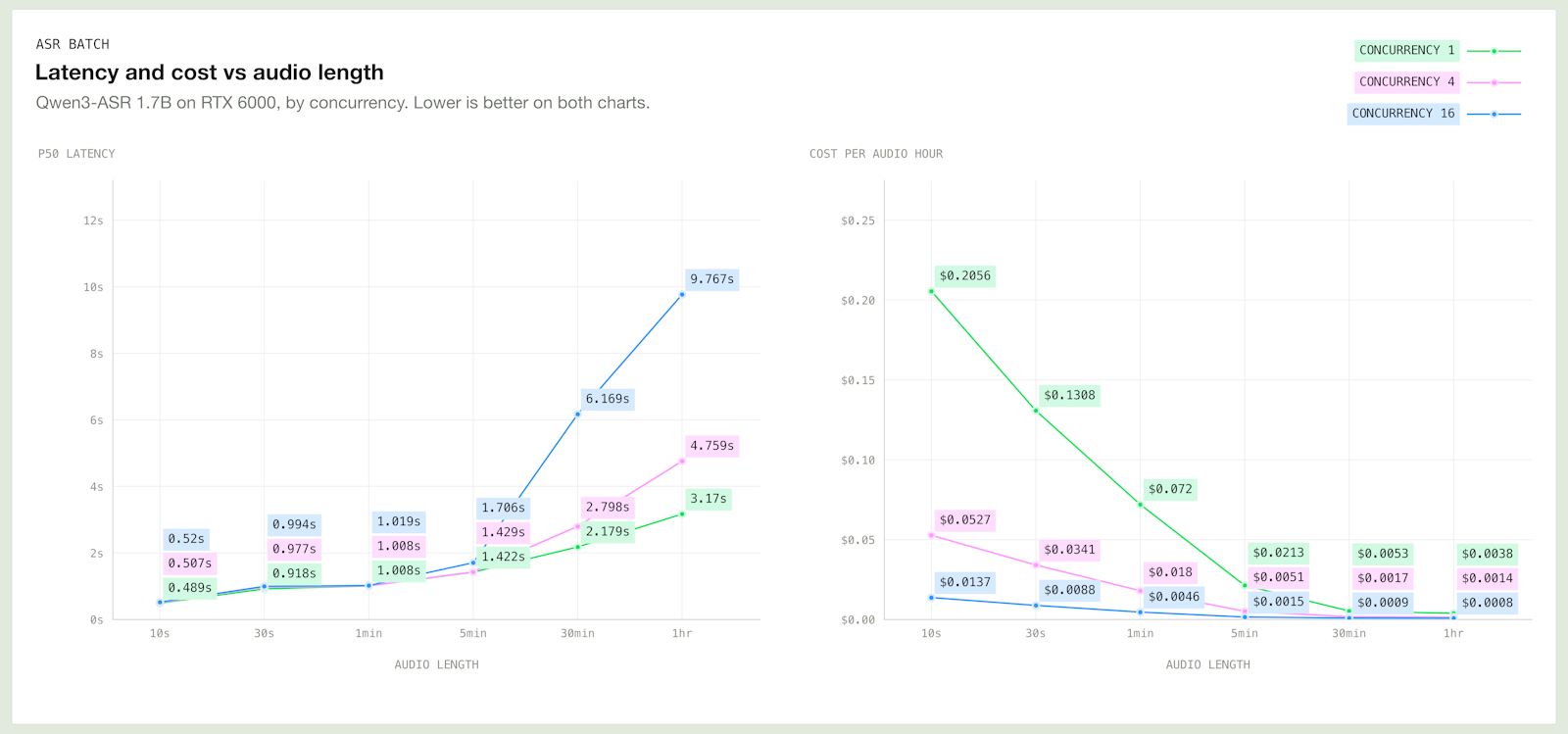
The charts below show median latency and unit economics (cost per audio hour) change with audio length when transcribing prerecorded files at 1, 4 and 16 concurrent requests per GPU. Higher concurrency significantly reduces cost per audio hour, with a corresponding tradeoff in latency that grows with audio length.
Concurrency is configurable and can be tuned to achieve the latency and cost targets that best fit your workload and business requirements. See the concurrency guide for configuration details.
For batch workloads, we recommend starting with H100 using concurrency 16, and lowering it to reduce latency on longer audio or raising it to increase throughput on latency tolerant workloads
Using the model
It serves the OpenAI-compatible /v1/audio/transcriptions endpoint, and diarization and timestamps are on by default. Request verbose_json to get parsed speaker segments.
Input
from pathlib import Path
from openai import OpenAI

model_id = ""  # Place your Baseten model ID here.

client = OpenAI(
    api_key="BASETEN-API-KEY",
    base_url=(
        f"https://model-{model_id}.api.baseten.co/"
        "environments/production/sync/v1"
    ),
    timeout=600.0,
)

with Path("audio.wav").open("rb") as audio_file:
    response = client.audio.transcriptions.create(
        model="OpenMOSS-Team/MOSS-Transcribe-Diarize",
        file=audio_file,
        response_format="verbose_json",
        extra_body={"max_new_tokens": 65536},
    )

print(response.to_json())
# Speakers are inline [S01], [S02], ... tags at the start of each segment's text.