
Please rotate your device
To continue exploring this website, please rotate your device to a vertical orientation













Agentic coding is the fastest-growing line item. But different parties care about competing goals, and the landscape is shifting fast.

FINANCE AND PROCUREMENT
Want the bill to come down, knowing not all tasks require frontier intelligence.

INDIVIDUAL ENGINEERS
Want high-quality code and high speed of iteration.

ENGINEERING LEADERS
Want objective evidence that backs up the best path to productive teams and full control of the stack.
Your harness and models, governed in one place.
Developers keep their setup. Maintain quality output using cost-efficient models. Gateway, routing, and guardrails.is thi
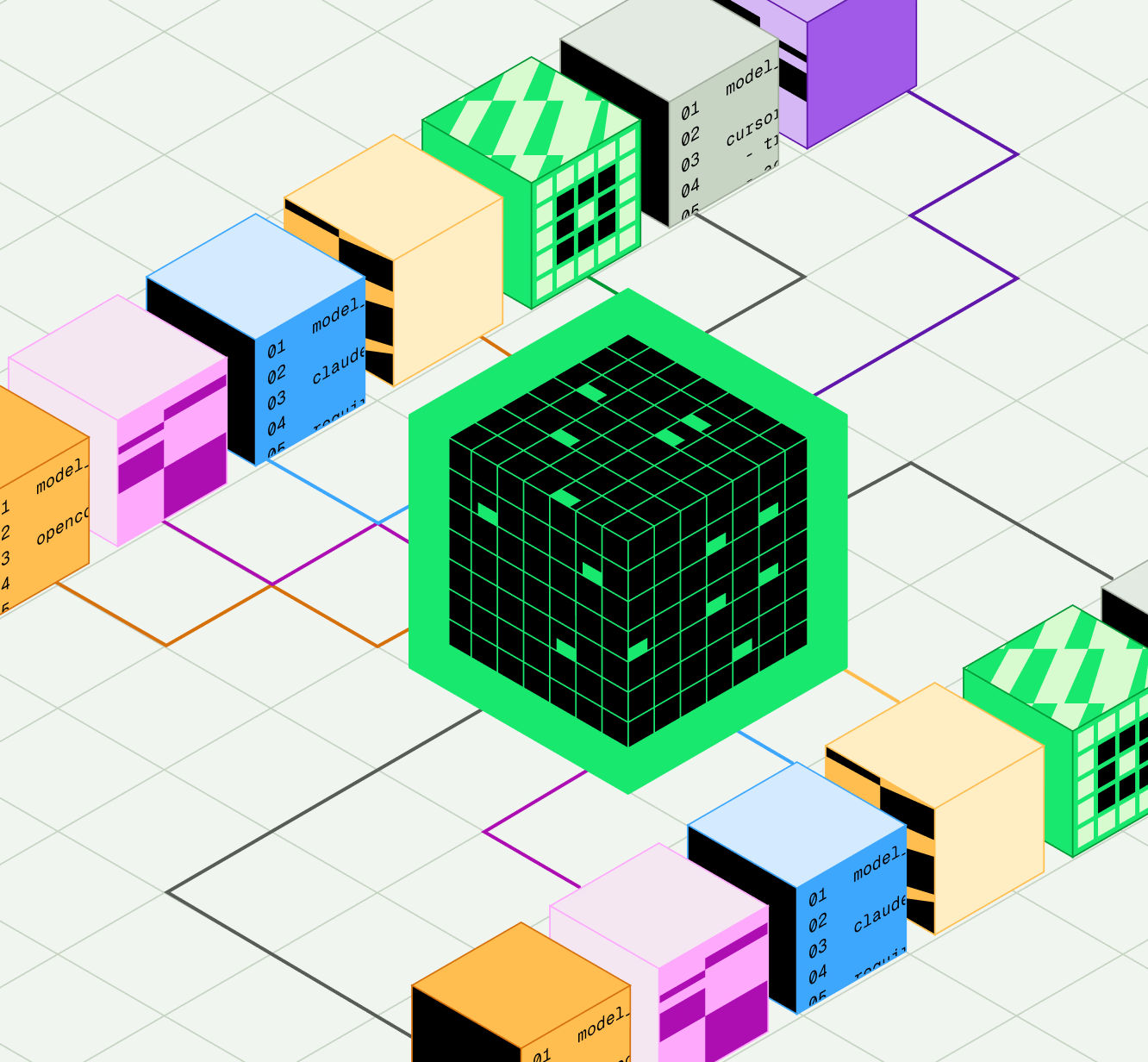
Engineers keep Claude Code, Codex, OpenCode, Pi or your internal harness. Only add new model paths.
Point an existing harness at Baseten with Grid or Switch.
Same tool calls, skills, MCPs supported across Baseten.
No lock-in: Compatible with closed-source and any models your team needs.
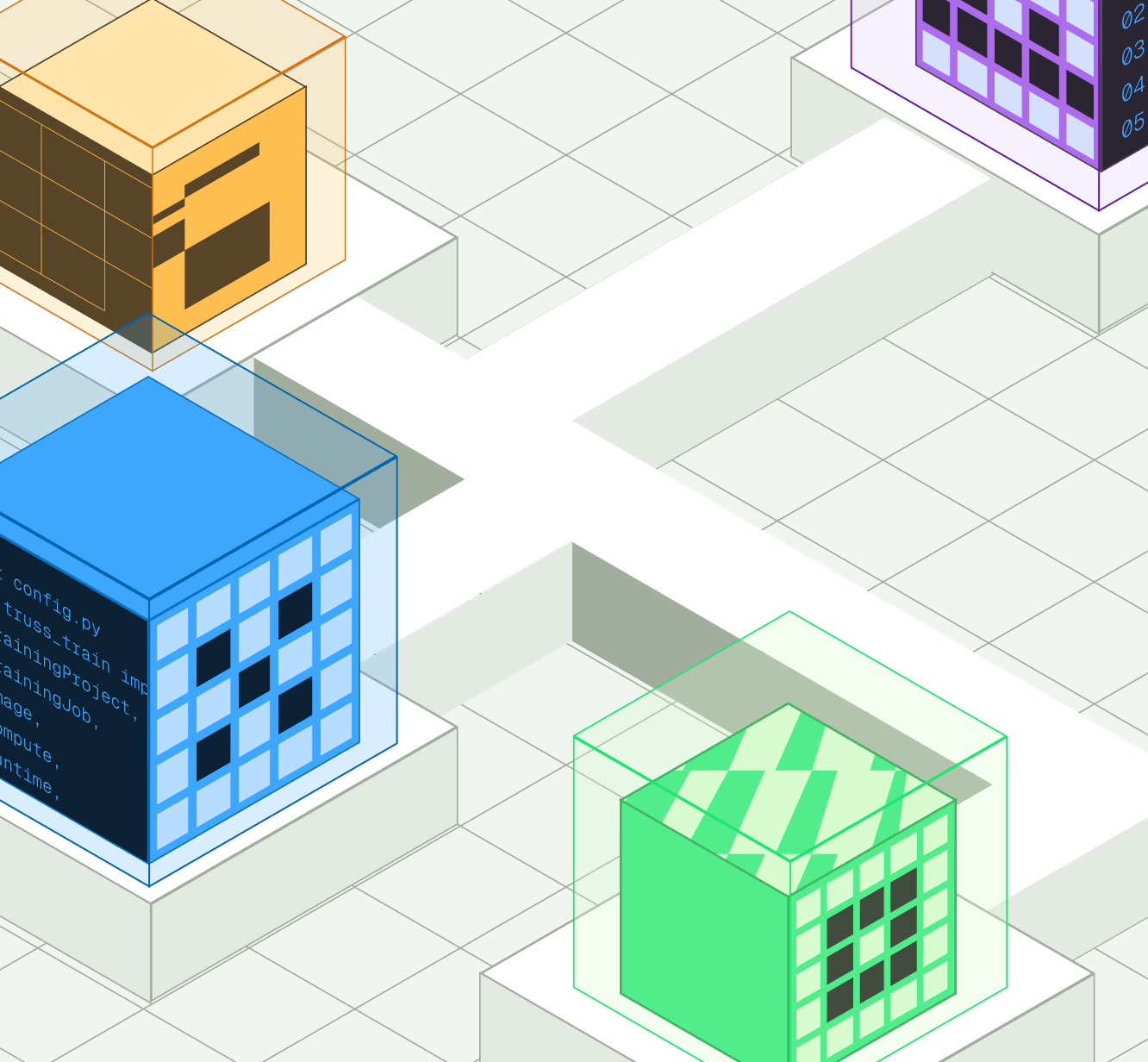
Find your model-task fit. Open models take the work based on evals that match your actual codebase. Frontier models handle the rest.
GLM, Kimi, DeepSeek available on day zero, or your own post-trained checkpoints.
Evaluate new models on tasks built from your production codebase.
Measure cost and time per completed task, performance and reliability across your model fleet.
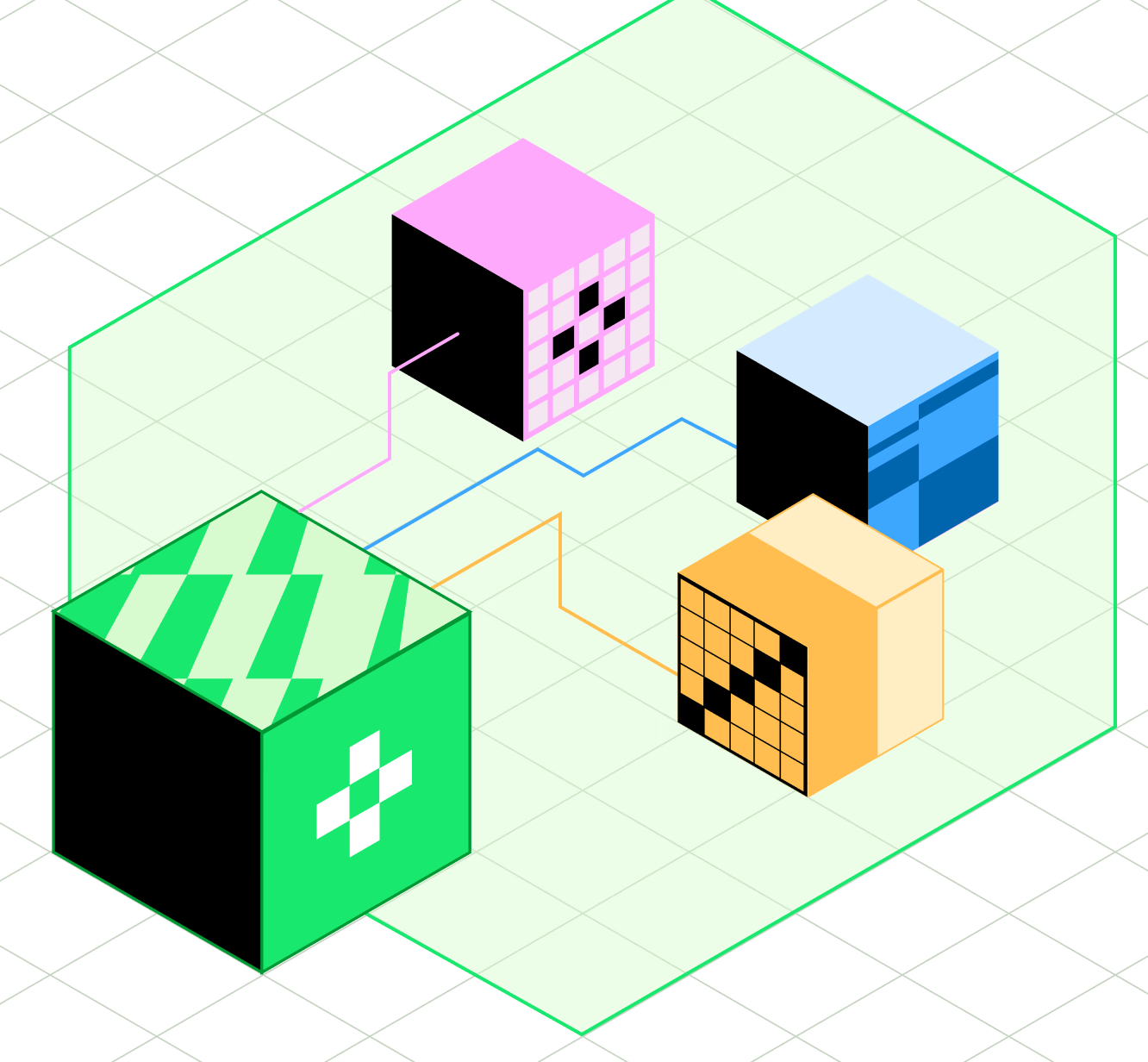
Developers connect your harness in one place. You have full observability and governance.
Approve any models once across Baseten, OpenAI, and Anthropic.
One central key. Developers get their own gateway key that works nowhere else.
Set a budget per team or agent.
Route requests flexibly to the right models each time.

Working with Baseten has allowed us to focus less time on our serving and capacity needs and more on the quality of the output we’re getting from the models.
, VP of Engineering

Keep the harness. Prove models on your own production codebase.
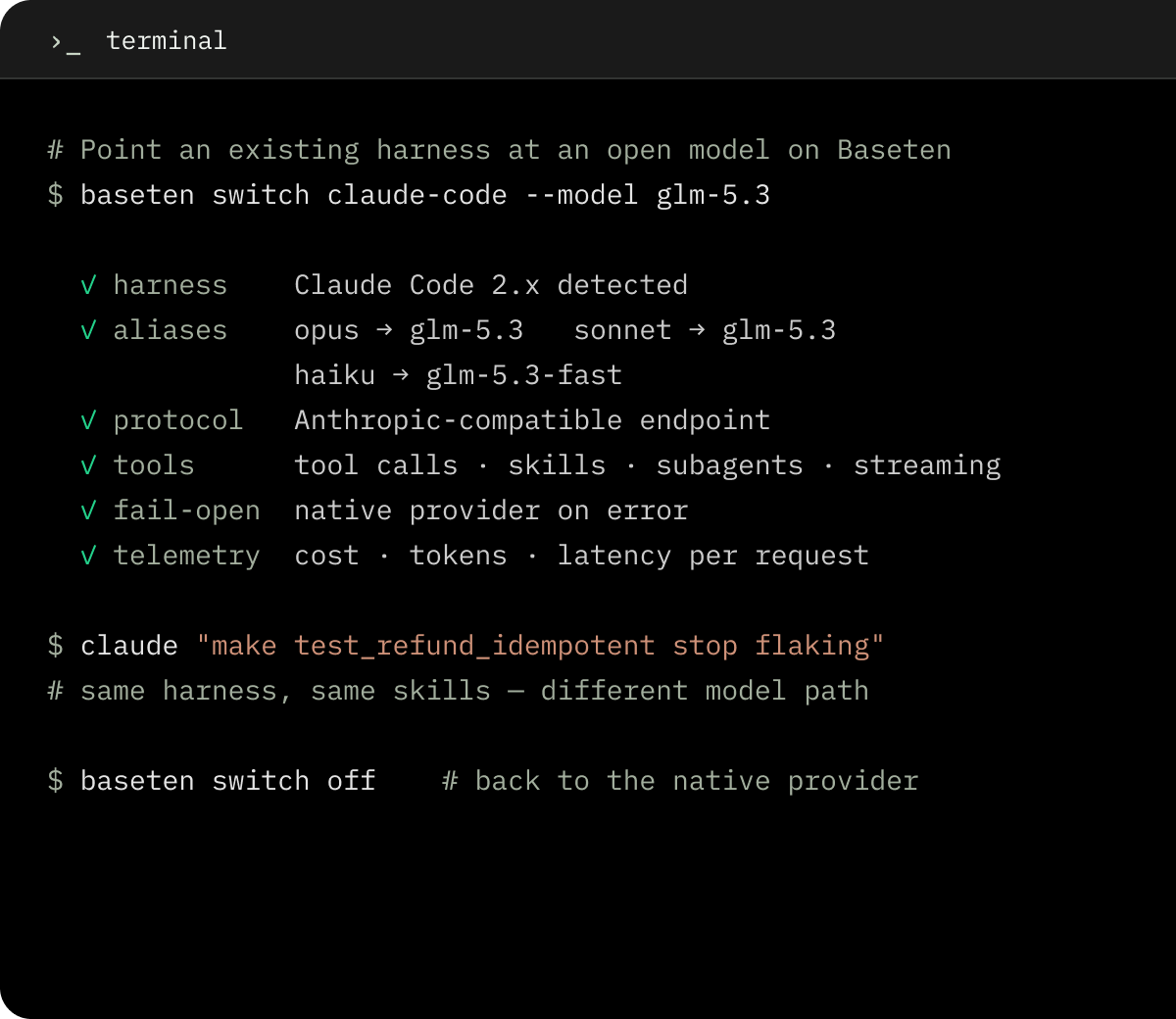
Use Baseten Grid to route to a Baseten-hosted model without hand-editing environment variables. Aliases, streaming, tools, and skills keep working alongside other closed models you already have.
Keep your gateway if you run one. Baseten Model APIs sit behind LiteLLM, a homegrown proxy, or another control plane. If there is none, use Baseten Gateway to provision every team with unique keys, usage attribution, and approved-model policy.
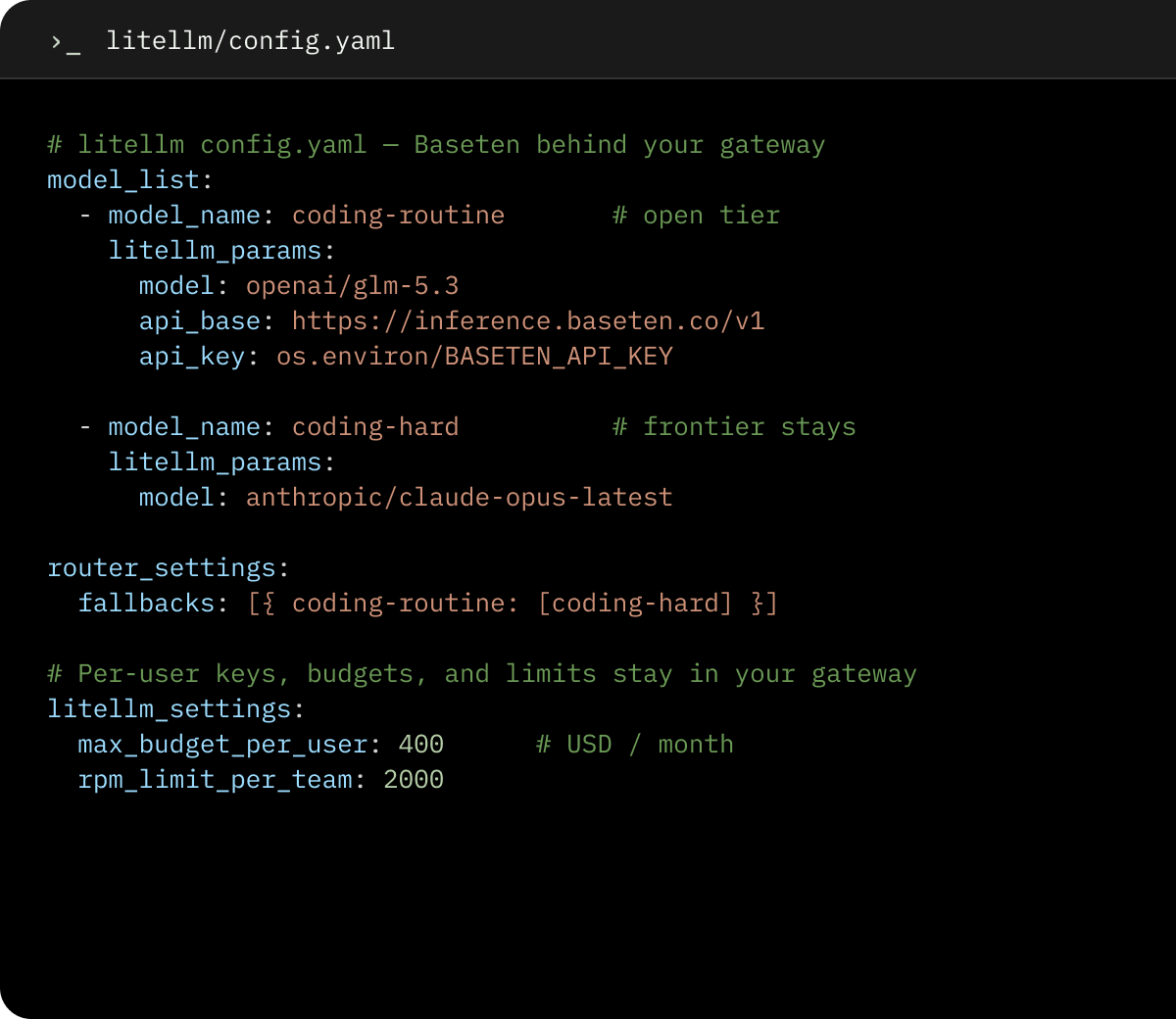
Keep your gateway if you run one. Baseten Model APIs sit behind LiteLLM, a homegrown proxy, or another control plane. If there is none, use Baseten Gateway to provision every team with unique keys, usage attribution, and approved-model policy.
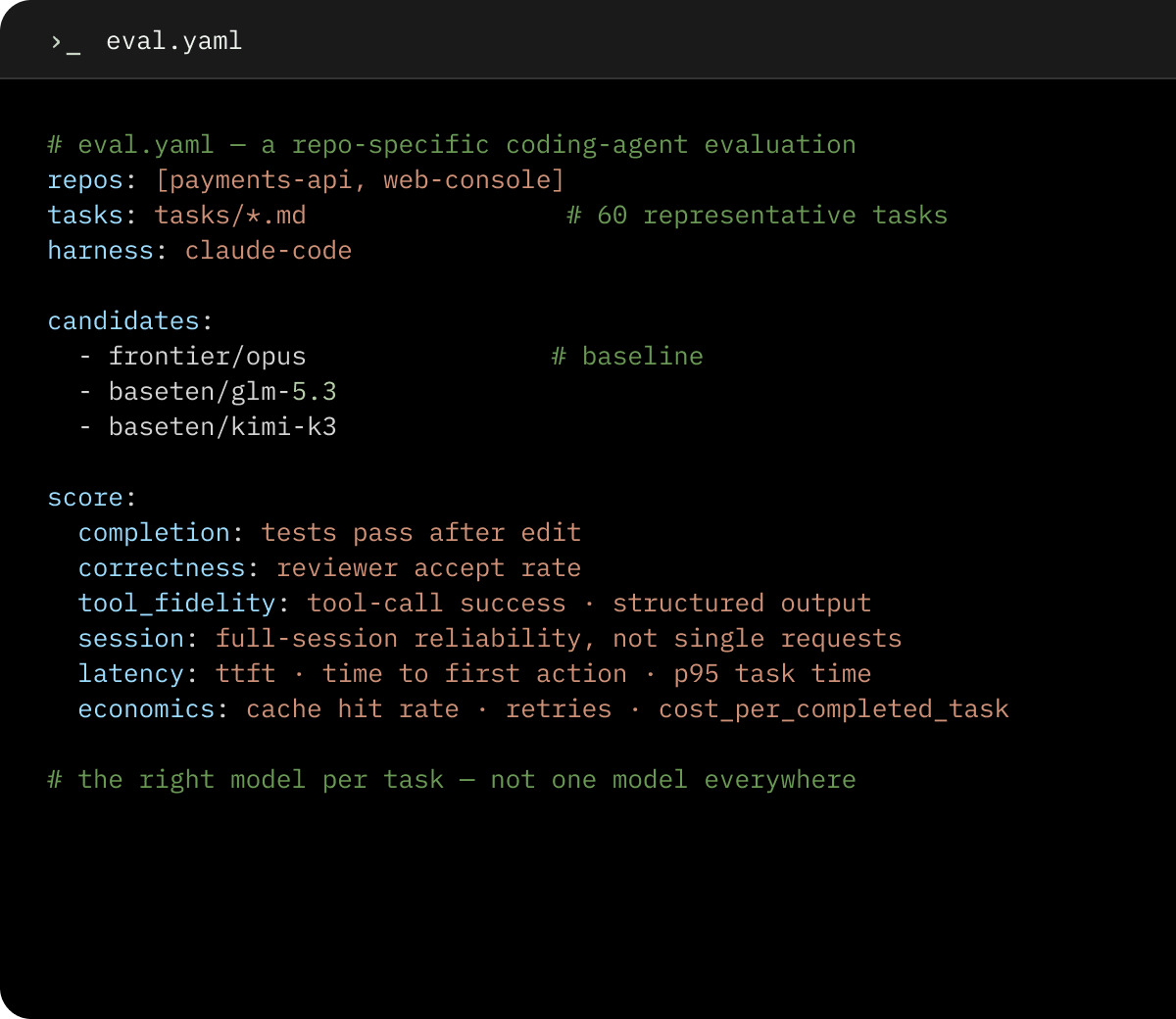
Run representative tasks and measure completion, tool-call fidelity, latency, cache hit rate, retries, and cost per completed task to establish an objective view. Our engineers can help you design the evaluation and benchmark the results.


Your codeYour model
When off-the-shelf isn't enough, train on your traces for review, repair, test generation, or tool use. Serve your checkpoint on dedicated capacity.
DeepSeek V4.1 Flash 1017
DeepSeek/DeepSeek V4.1 Flash 1017
P50 TPS
250
P50 TTFT
0.13s
DeepSeek V4.1 Flash Fast
DeepSeek/DeepSeek V4.1 Flash Fast
Kimi K3.1 Pro
Moonshot AI/Kimi K3.1 Pro
GLM-5.3
Z AI/GLM-5.3
P50 TPS
300
P50 TTFT
0.2s
GLM-5.3-Flash
Z AI/GLM-5.3-Flash
P50 TPS
120
P50 TTFT
0.25s
Nemotron 3.5 Super VL
NVIDIA/Nemotron 3.5 Super VL
P50 TPS
570
P50 TTFT
150
High-quality coding powered by models you tuned for performance and cost.

Own your data, intelligence, and destiny.
Zero data retention by default, SOC 2 Type II certification, and hosting options for data residency and HIPAA requirements across all deployment types.

The earliest support on new models.
Open models are production-ready on Baseten fast, so your team can test new models on the Pareto frontier.

Infrastructure that maximizes your savings and performance.
KV-cache-aware routing sends each request to the replica already holding the session’s context to reduce recomputation.

Code-tuned runtimes.
Model-specific engines, kernels, quantization, speculative and lookahead decoding, continuous batching, and prefill tuned to long-context. Optimizations to support long-running coding agents.

Understand and measure critical success metrics for development.
Cost per task, time per task, cache hit rate, retries, TTFT, and TPS — per user, team, and model.

Transparent control and full governance.
Use Baseten Grid or another Gateway to create per-user keys, per-minute and per-day limits, approved-model policy, and attribution.

Your fleet of frontier models.
Fall-backs and routing guarantee high uptime and reliability so your engineers never get blocked.
Coding agents your engineers love and those you fully control.
Start with one harness, one team, and an eval built from your own pull requests.
